

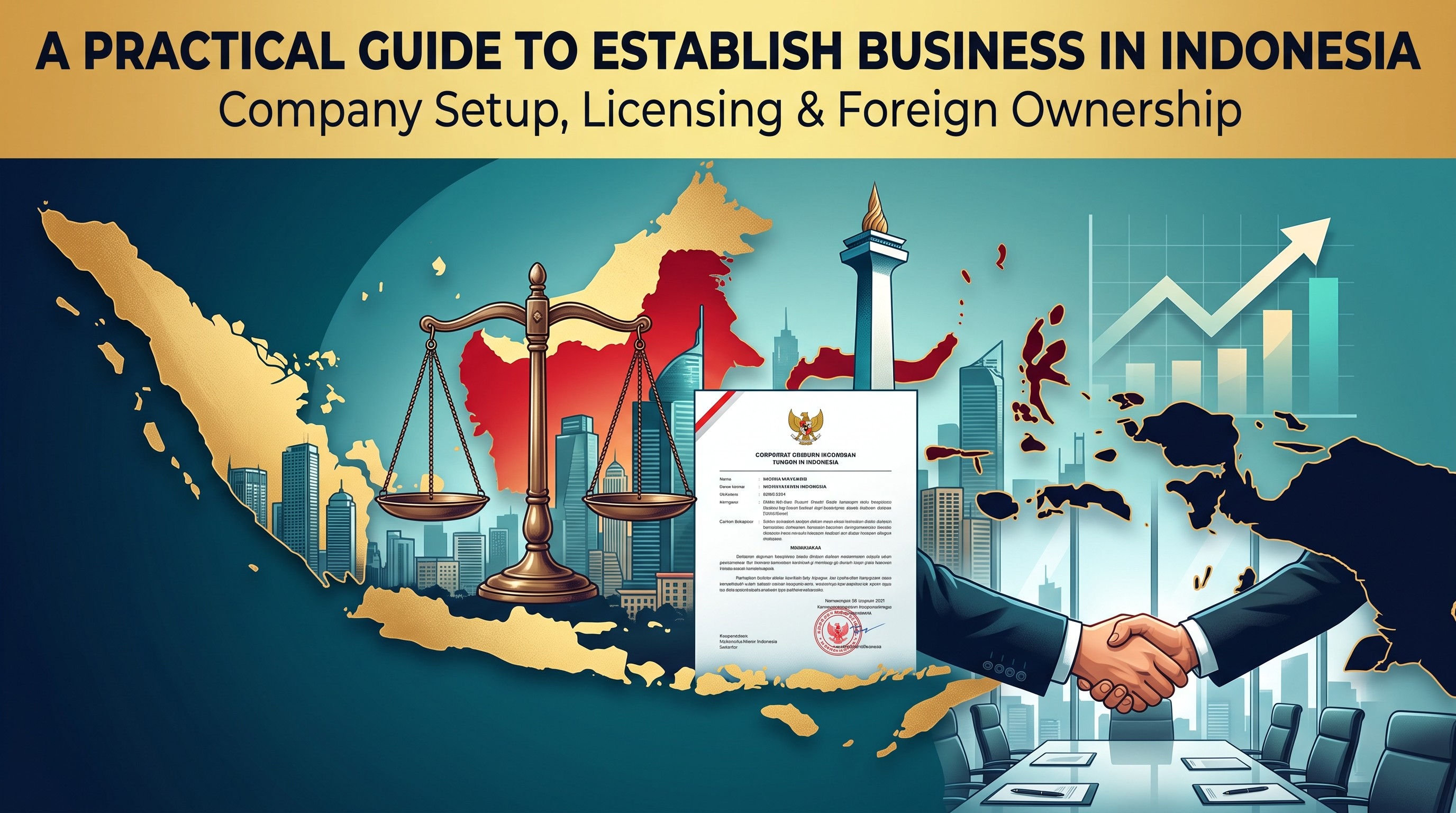
It is beyond
reasonable doubt that Indonesia provides a huge market for almost every
industrial sector ranging from real estate to financial services. Currently,
Indonesia is populated with more than 270 million citizens dominated with
productive classes. In addition to that, Indonesia provides invaluable natural
and mineral resources which are very important to support various manufacturing
industries.
In light of such
potential advantages, this article will provide some practical guidance for
investors to establish their businesses in Indonesia. There will be 4 (four)
points that will be addressed in this article, including: (i) Form of Business
Entity, (ii) Foreign Ownership Limitations, (iii) Business Classifications, and
(iv) Mandatory Business License.
Prior to the discussion, it is important to mention some of the regulations related to investment and business establishment in Indonesia, among others:
- Law No. 25 of 2007 on Investment (“Investment Law”);
- Law No. 40 of 2009 on Limited Liability Company (“Company Law”);
- Government Regulation No. 28 of 2025 on The Organization of Risk Based Business Licensing (“GR 28/2025”);
- President Regulation No. 10 of 2021 on Investment Business Fields (“PR 10/2021”); and
- Regulation of the Statistic Central Bureau (Badan Pusat Statistik or “BPS”) Regulation No. 7 of 2025 on Standard Classification of Indonesian Business Sector (“BPS Reg. 7/2025”).
Form of
Business Entity and Capital Requirements
Although not
strictly defined in Indonesia’s regulatory framework, business entities shall
refer to the economical unity which is utilized to gain economic benefits.
Business entities are means by which businesses are managed and operated on the
daily basis.
Business
entities can be divided into 2 (two) classification: business entities with
legal personality and business entities without legal personality. The former
includes the Limited Liability Company (Perseroan Terbatas or “PT”),
one of the well-known and well-structured business entity with legal
personality under Indonesian regulatory framework.
In this article,
we will be focused primarily on PT as it is the only form of business entity
that is allowed for foreign investment as stipulated in Article 5 (2) of Investment
Law. It should be noted that establishing business in the form of PT offers
various benefits as well, including the benefits of limited liability (where
shareholders’ liabilities are limited to the capital) and also the benefits of
separate legal entity (where corporation can act and also be prosecuted by
themselves without involving the shareholders).
During its
establishment, it is mandatory that a PT is established by at least 2 (two) parties
(person and/or legal entity) which take parts as the shareholders of the
company. Such establishment also needs to be made in written in the form of a
notarial deed before a public notary. Additionally, the establishment will also
be registered to the Ministry of Law in order to grant the newly established
company its full legal status and capacities (Article 7 (1) – (3) Company
Law).
With regard to
the capital requirements, it is important to distinguish between 2 (two) types
of capital which consist of (i) authorized capital; and (ii) paid-up capital. Such
differentiation is important to analyze the capital requirements for the
establishment of PT.
Generally, as
stipulated in Article 32 (2) of Company Law, the amount of authorized capital
shall subject to the decision of the founders. Such provisions give flexibility
to founders in deciding the amount of authorized capital determined by business’
scope, scale, and activities.
However, for
foreign investment companies, Article 212 of GR 28/2025 requires additional
minimum investment in the amount of IDR 10 billion per business activity per
location. Such requirements must be brought in considerations while determining
the amount of company’s authorized and paid-up capital as well.
Business
Classifications
As we discuss the provisions on business classifications, historically, Indonesia has implemented the Risk Based Business Licenses as of 2021. Under this new licensing regime, business activities are classified based on its potential risk (Article 1 (2) of GR 28/2025). Business activities are further classified in the following categories:
- Low risk business activities;
- Medium-low risk business activities;
- Medium-high risk business activities; and
- High risk business activities.
(Article 128
(1) – (2) GR 28/2025)
Furthermore, all
applicable business activities in Indonesian jurisdiction are classified by BPS
in various codes combination. Such codes are known as the Standard
Classification of Indonesian Business Sector (Klasifikasi Baku Lapangan
Usaha Indonesia or “KBLI”).
The KBLI codes
are stipulated and introduced by BPS through BPS Reg. 7/2025. Under this
regulation, there are more than 1,500 applicable KBLI Codes for various
business activities. The KBLI Codes covers 22 (twenty two) business categories
ranging from Agriculture, Forestry, and Fisheries to Activities of
International Organizations and Other Extra-International Bodies.
Foreign
Ownership Limitations
It is also
noteworthy that some of business activities marked by particular KBLI Codes subject
to foreign ownership limitations. In general, such limitations are stipulated
in PR 10/2021. The limitations can be in the form of prohibition for foreign
investment (100% domestic ownership) or prohibition for foreign investors to be
majority shareholders (maximum of 49% of foreign ownership).
Some of the business
activities which are subject to foreign ownership limitations as stipulated in
PR 10/2021 are as follows:
|
Industry |
KBLI Codes |
Limitation |
|
Coffee with geographical indications processing
industry |
10761 |
Closed for foreign investment. 100% domestic
ownership |
|
Batik Industry |
13133 |
Closed for foreign investment. 100% domestic
ownership |
|
Domestic maritime transportation for tourism |
50113 |
Foreign ownership is limited to maximum of 49% |
Please be
informed that limitations in PR 10/2021 are only regulated in general level. Some
of the technical regulations issued by respective regulators in charge of
supervising particular business activities also stipulate such limitations. For
instance, for insurance companies, the foreign ownership is limited to maximum
of 80% of the paid-up capital as stipulated in Government Regulation No. 14 of
2018 on Foreign Ownership of Insurance Companies as amended by GR No. 3 of
2020.
Therefore, it is
still advised that investors that plan to invest in Indonesian market to
conduct a thorough legal review over targeted business activities. This is to
ensure that prospective investors gain a complete overview over the targeted
business activities before finally come into decision to invest.
Mandatory
Business Licenses
As mentioned
above, within the Risked Based Business Licensing regime, the mandatory
business licenses are stipulated based on the inherent risk of particular
business activities. We have discussed that business activities are classified
into 4 (four) classification categories. Such classification categories are
important to determine what kind of business licenses required.
As stipulated in
Article 130 – 133 of GR 28/2025, the mandatory business licenses for each
classification categories are as follows:
|
Risk Based Business Classification |
Applicable Business License(s) |
|
Low |
Business Identification Number (Nomor
Induk Berusaha or “NIB”) |
|
Medium Low |
NIB and Standard Certificate |
|
Medium High |
NIB and Standard Certificate |
|
High |
NIB and Permit |
Conclusion
Indonesia offers
invaluable market and potential for investors to establish their business. All
business activities are properly regulated under the prevailing laws and
regulations. These regulations cover various aspects of business activities
including form of business entity, capital requirement, foreign ownership
limitations, and provisions regarding business licenses.
It is highly advised for investors to conduct a through legal review over applicable regulations before taking into consideration to invest in Indonesia. This to ensure that investors obtained full and proper knowledge of regulatory requirements for establishing business in Indonesia. For investors who have established their business in Indonesia, such legal review is also advised in order to maintain and fulfil business compliance to the prevailing regulations.
Informasi dan pendapat dalam tulisan ini disajikan semata-mata untuk tujuan informasi dan edukasi publik. Dan tidak bertanggung jawab atas segala bentuk penggunaan, penafsiran, maupun keputusan yang diambil berdasarkan isi tulisan ini. Pembaca diharapkan melakukan verifikasi dan penilaian secara mandiri sesuai kebutuhan.





0 Komentar:
Login